What is Rajasthani Dress Code? Traditional Clothing of Jaisalmer Men & Women Explained
Overview
Walk through the lanes below Jaisalmer Fort and colour hits you from every direction: saffron and red turbans, swirling skirts in deep pink and green, veils edged with mirrors, silver anklets and rows of bangles. Traditional Rajasthani dress is not a costume put on for tourists. In Jaisalmer and the surrounding desert villages, it is still daily wear for many families, and it carries information about community, age, marital status, season and celebration. This guide explains the traditional clothing of Jaisalmer men and women, what each garment is called and how it is worn, why the desert produces such strong colours, what visitors should wear themselves, and where you can buy or try authentic pieces at fair prices.
Traditional Clothing of Jaisalmer Men
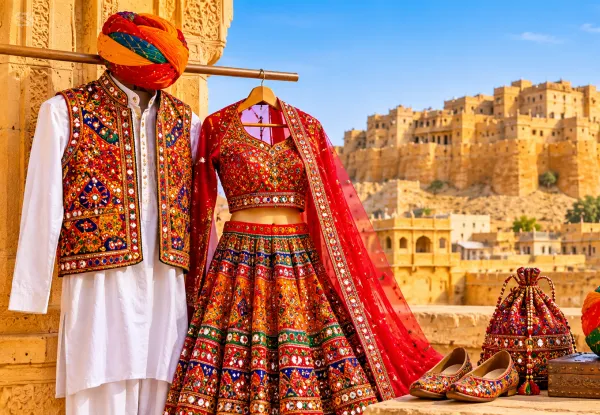
The most recognisable item in a Jaisalmer man's wardrobe is the Rajasthani turban, known locally as a safa or pagri. A turban is made from a single long strip of cotton or fine muslin, usually between seven and nine metres long, wrapped by hand around the head in a style that varies between communities and regions. In the desert, the turban protects the head from the burning sun in summer and from cold winds in winter, and the loose end can be pulled across the face during a dust storm. Herders and camel men often tie their turbans loosely for comfort, while men at weddings and festivals wear tightly wrapped, carefully shaped turbans that can take ten to fifteen minutes to tie.
Colour and pattern in a turban send clear signals. Bright saffron, red and pink suggest celebration, weddings and festivals. Five-coloured turbans are associated with royal and festive occasions. White or pale turbans are often worn during mourning or by older men, and dark shades such as maroon and khaki are common for daily work. The wave-pattern dyed fabric called leheriya is worn during the monsoon festival of Teej, while bandhej, a tie-dye pattern of tiny dots, is popular at weddings. Manganiyar and Langa musicians who perform at desert camps often wear striking bright turbans that have become part of their identity on stage.
Below the turban, older men in villages wear a long white cotton cloth wrapped around the waist and legs, called a dhoti, paired with a short upper garment called an angarkha, which ties at the side rather than buttoning down the front. The angarkha's crossover cut traps a layer of air against the body, keeping the wearer cooler in heat and warmer at night. Younger men commonly wear a long cotton kurta shirt with straight trousers or a dhoti, especially for festivals and family events. Many herders also carry a woollen shawl or blanket in winter, used as a wrap during the day and as bedding at night.
Footwear completes the outfit. Mojari, also called juttis, are hand-stitched leather slippers with a pointed or curled toe, often decorated with embroidery and small beads. Plain everyday pairs cost about Rs.500 to Rs.1,200 in Jaisalmer's markets, while embroidered wedding styles cost Rs.1,500 to Rs.3,500. Men also wear silver or gold earrings, rings and sometimes a thick silver chain. Moustaches are part of the traditional look, and the Jaisalmer Desert Festival in February even holds a moustache competition alongside its famous turban-tying contest, where local men and visitors compete to tie the neatest turban in the shortest time.
Royal and formal dress sits at the far end of the scale. For weddings and ceremonies, Rajput men wear a long fitted coat called an achkan or sherwani in silk or brocade, with a matching turban and a sash at the waist. These outfits can cost Rs.15,000 to Rs.60,000 or more for tailored pieces. Visitors can see historical versions inside the Jaisalmer Fort palace museum, where portraits and preserved garments show how the ruling family dressed in earlier centuries.
Dress Comfortably, Explore Rajasthan Confidently
Prepare for Rajasthan with practical clothing tips and local insights. Enjoy comfortable sightseeing, discover traditional culture and experience Jaisalmer’s attractions with a personalised desert travel itinerary.
WhatsApp Now Contact Us
Traditional Clothing of Jaisalmer Women
Women in Jaisalmer and the surrounding villages traditionally wear three main pieces. The first is the ghagra, a long, full skirt gathered at the waist and flaring out towards the ankles. Village ghagras use several metres of cotton and swirl dramatically when the wearer walks or dances, which is why they feature so prominently in folk performances such as the Kalbelia dance. Festival and wedding ghagras are made from silk or georgette and decorated with mirror work, zari metallic thread, appliqué and borders. A simple cotton ghagra costs Rs.1,500 to Rs.4,000 in local markets, while an embroidered festival set can cost Rs.6,000 to Rs.25,000.
The second piece is a fitted blouse or backless bodice called a kanchli or choli, often paired with a short tunic called a kurti. The third, and most symbolic, is the odhni, a long veil of light fabric draped over the head and shoulders and tucked into the skirt. The odhni covers the head as a mark of modesty and respect, especially in the presence of elders, and protects the face and hair from sun and dust. Different communities drape it in slightly different ways, and the pattern and colour of the odhni often show whether a woman is married, widowed or celebrating a particular occasion.
Jewellery is central to a Jaisalmer woman's dress. The borla, a round ornament worn on the forehead and attached by a chain to the hair, is one of the most distinctive pieces of Rajasthani jewellery and is worn by married women. Heavy silver anklets, nose rings, earrings, necklaces and armlets complete the set. In many desert communities, women wear rows of bangles from wrist to upper arm, traditionally made of ivory and today of bone, plastic or lacquer. Silver jewellery in the old styles is sold by weight in Jaisalmer, with simple anklets starting around Rs.4,000 and heavy traditional sets running well above Rs.20,000.
Textile techniques give women's clothing its character. Bandhej, the tie-dye method that creates fields of tiny dots, is done by tying small portions of cloth with thread before dyeing, and fine pieces can take weeks to complete. Leheriya, the diagonal wave pattern, is linked to the monsoon and the festival of Teej. Block-printed cottons from towns such as Barmer and Sanganer, mirror-work embroidery from desert villages, and gota patti, an appliqué of gold and silver ribbon, are all common. A good bandhej or leheriya odhni costs Rs.l700 to Rs.3,000 depending on fabric and fineness.
Daily life shapes how women dress. In villages around Jaisalmer, women work in fields, fetch water, herd goats and run households in these garments, and the full skirt and veil are practical for sitting on the ground, carrying loads and shading the face. In town, younger women often wear salwar suits or saris for daily life and keep the ghagra and odhni for festivals, weddings and temple visits. During festivals such as Gangaur in spring and Teej in the monsoon, entire neighbourhoods of women dress in matching colours, creating some of the most striking scenes in Rajasthan.
Colours, Fabrics and the Meaning Behind Them
People often ask why the desert produces such bright clothing. One practical explanation is visibility: in a landscape of sand, scrub and stone, strong reds, yellows and greens stand out across long distances, helping herders and families spot each other. Another is mood. Life in the Thar can be harsh, with long dry seasons, extreme heat and limited resources, and bright clothing brings energy and celebration into daily routines. Colour also marks the calendar, with specific shades and patterns tied to festivals, seasons and family occasions.
Fabric choice follows climate. Cotton dominates for daily wear because it breathes in the heat and absorbs sweat. Light muslin turbans keep heads cool, while thicker cotton and wool are used for winter shawls and blankets. Silk and synthetic fabrics appear mainly at weddings and festivals. Natural dyes from plants, minerals and insects were once standard, with indigo, madder and turmeric giving deep blues, reds and yellows, though most fabric today uses chemical dyes. A few workshops in western Rajasthan still practise natural dyeing, and their pieces command higher prices.
Certain combinations carry specific meanings. Red is the colour of marriage and auspicious beginnings, worn by brides and at weddings. Yellow and saffron are linked to spring, celebration and religious devotion. Green represents fertility and new growth. White and muted shades signal mourning or older age. Black, often with red or mirror work, is associated with the Kalbelia community, whose women perform the famous snake-charmer dance in flowing black skirts. Reading these colours adds a new layer to time spent in the markets and villages.
Community identity is visible in dress too. Rajput families, merchant communities, herders, Bhil and Meghwal groups, and the hereditary musician communities each have their own preferences in turban style, jewellery and embroidery. A trained eye can often tell where someone comes from by how they tie their turban or which patterns appear on a woman's odhni. Our guides on village tours explain these differences while walking through settlements, which makes the clothing you see far more meaningful than a quick photograph.
Modern influences have changed what young people wear daily, with jeans, T-shirts and casual shirts common among men in Jaisalmer town. Yet traditional dress remains strong for weddings, festivals and village life, and many young men still wear turbans for special occasions with obvious pride. The tourist economy also supports traditional crafts, since visitors buy turbans, embroidered bags, ghagras and jewellery, keeping skills alive in villages where other income is limited.
Let Rajasthan’s Traditions Inspire Your Journey
From colourful traditional clothing to warm desert hospitality, discover what makes Rajasthan unique. Experience its heritage, explore Jaisalmer’s beauty and create lasting memories with local travel experts.
WhatsApp Now Contact Us
What Visitors Should Wear and Where to Try Traditional Dress
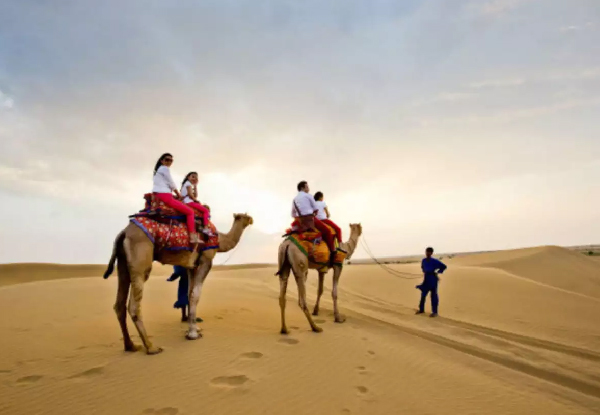
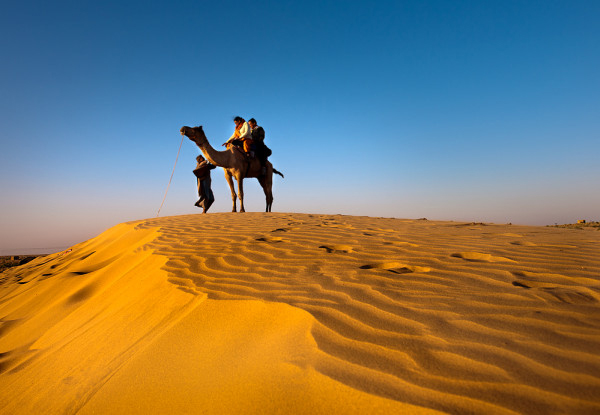
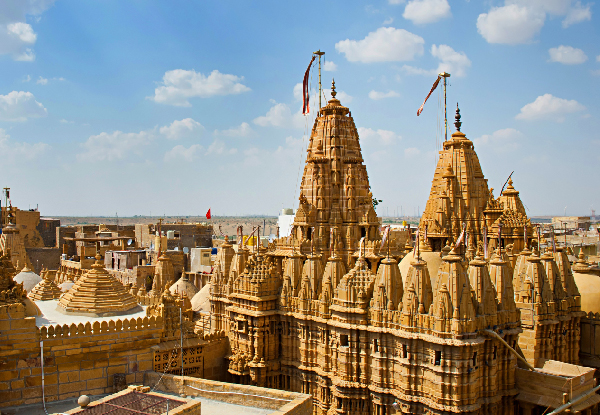
Visitors are not expected to wear traditional dress, but a few clothing guidelines make every visit smoother. In the fort, the Jain temples and village homes, cover shoulders and knees. Long cotton trousers, loose skirts, linen shirts and a scarf work for everyone. Leather items such as belts and bags are not allowed inside the Jain temples, and shoes must be removed at temple entrances. For desert trips, wear comfortable trousers for camel riding, closed shoes for walking on hot sand, a hat or scarf for the sun, and warm layers for winter nights, which can drop to 5°C.
Trying traditional dress is a highlight for many guests. Photographers and stalls around the fort and at Sam Sand Dunes rent costumes for photographs, typically charging Rs.200 to Rs.500 per person for a turban and outfit and the use of a backdrop. At many desert camps, staff happily tie a turban on guests in the evening, and on our luxury overnight camping tour, the cultural programme often includes a turban-tying moment and dancing with the performers. During the Desert Festival in February, visitors can even enter the turban-tying competition.
Buying authentic pieces is easy if you know where to look. Ready-to-wear turbans in printed cotton cost Rs.300 to Rs.800, fine muslin or bandhej turbans Rs.800 to Rs.2,500, and pre-tied turbans that slip on like a hat Rs.500 to Rs.1,500. Embroidered ghagra and odhni sets range from Rs.3,000 for simple cotton to Rs.25,000 or more for heavy festival work. Manak Chowk, Sadar Bazaar and the fort lanes have many textile shops, and the Khadi showroom near Seema Gram offers fixed-price cotton fabrics. Ask shopkeepers to show you how to tie or drape each piece before you leave.
The best way to see traditional clothing in its real setting is in the villages. Our Real Desert Adventure Safari with village tour, priced at Rs.7,200 plus tax per adult for two nights, includes a camel ride to desert villages where families still dress in traditional styles, along with lunch in the shade and time to talk with residents. The Indian musical village tour takes you to a community of hereditary musicians, where turbans, jewellery and traditional dress are part of every performance and family gathering.
Photography etiquette matters with traditional dress. Many women in villages prefer not to be photographed, and some will cover their faces with the odhni when a camera appears. Always ask first, accept a refusal politely and never photograph children without a parent's agreement. Guides can help ask on your behalf and explain the purpose. A few minutes of conversation before raising a camera usually leads to warmer interactions and far better portraits.